

Workspace sheet and recovery
The web and mobile picker fills the screen, with the Tuturuuu logo, Workspaces heading, floating Search/Create controls, close and Back support. Search and sorting retain workspace IDs and the objects from the rendered results. Duplicate names cannot substitute a different workspace when a list refreshes. Hidden workspaces are absent from current/default choices and workspace filters. Settings → Hidden workspaces opens a focused restore editor; restoring changes only the private preference, without selecting a scope or changing the default. A picker with all workspaces Hidden also offers recovery. Empty preferences, unknown preferences, no memberships and all-Hidden memberships are distinct. Mobile switches an actively hidden selection to a visible default, personal or deterministic first visible workspace. Hiding the last visible workspace clears the active UI selection and opens the selection/recovery surface. The stored default remains unchanged and is skipped during normal mobile selection while Hidden. A browser keeps its existing authorized workspace URL when a choice is hidden; it offers no Hidden choices in the sheet. Existing authorized deep links and notification navigation may enter a Hidden workspace without restoring it. These rules change discovery, not permission checks. The following local widget capture uses a synthetic guest fixture, bundled font and the shared app theme. It contains no real account or workspace data.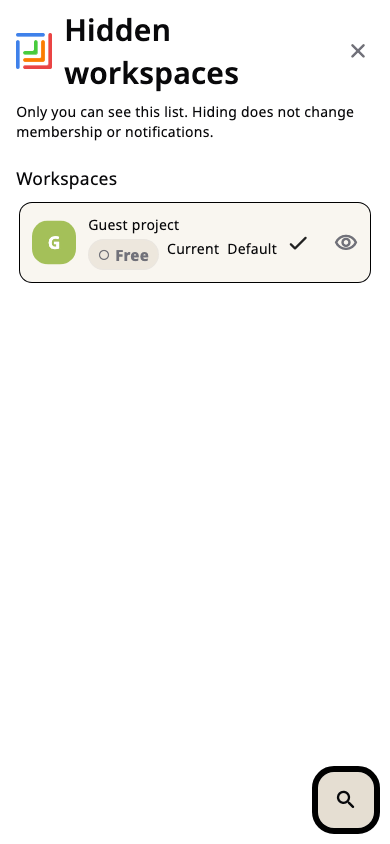
Persistence and actor boundaries
The existingpublic.user_workspace_configs table stores
(user_id, ws_id, id = 'HIDDEN_WORKSPACE', value = 'true'). An absent row means
visible. Board-share-only guests have no membership row, so their preferences use
existing owner-only public.user_configs rows:
(user_id, id = 'HIDDEN_WORKSPACE:<workspace UUID>', value = 'true').
The owner GET returns the union, with valid UUID IDs only. This uses one key per
workspace and avoids concurrent updates overwriting a whole list. Restore clears both stores across either membership transition. A former member
who still has a validated board share cannot delete the old member row through
membership RLS, so the server performs only that exact owner/workspace/key cleanup
after current access validation. No membership is created or RLS policy changed. There is no new schema or grant. user_private_details must not be used:
its shared-member read policy would expose a preference intended to be private.
GET /api/v1/users/me/hidden-workspaces?expectedActorId=<actor> returns only the
owner’s Hidden IDs with Cache-Control: private, no-store. PUT accepts
workspaceId, hidden and expectedActorId. The shared first-party app-session audience explicitly includes this endpoint, including Git. Owner GET additionally accepts the existing cli:access scope for CLI/MCP discovery; PUT does not accept CLI sessions. Unknown visibility fails discovery closed, while explicit MCP reads still use OAuth grants and canonical resource authorization.
The server derives the owner from
the authenticated session, compares the expected actor to reject a delayed
account-switch request, and verifies canonical membership of either MEMBER or GUEST before writing.
For choices discovered through direct task-board shares without membership, it
instead validates a live view/edit share for the actor’s canonical user ID or
owner email, on an undeleted board in the requested workspace. Share inspection
is server-only and read-only; preference writes remain owner-bound. Unknown or
failed access discovery denies the mutation. No membership is added. The existing
owner/membership RLS already permits both; no permission or policy is expanded. App
sessions also stamp and filter by the server actor when using their scoped
administrative client. The response is never joined into workspace/member APIs,
profile activity, audit summaries or notifications.
Web query keys and mobile encrypted cache keys include the authenticated actor.
Optimistic changes suppress duplicate writes, invalidate/revalidate private
queries, ignore stale refreshes and roll back failed server mutations. A confirmed
server update is not undone because a device cache write fails. Cold offline
state cannot claim an empty preference list; cached preferences remain usable
while refresh errors offer retry. Logout/account replacement invalidates mounted
work and prevents late responses from updating another account’s state.
Membership refreshes also retain cache-invalidation fences: a response that
arrives after its cache scope is cleared cannot confirm an empty membership or
cancel reminders. The actor is checked before a delayed response is cached.
reminder_membership_provenance_test.dart covers both invalidation and account
replacement against the actual repository and encrypted cache.
Canonical membership and consumers
MobileWorkspaceState.workspaces remains canonical for reminders, access,
notifications, deep links, task-board navigation, quotas and workspace data.
visibleWorkspaces and hiddenWorkspaces are separate UI projections. A list
with every membership Hidden never sets emptyMembershipConfirmed.
Web listWorkspaces, workspace summary APIs and permission discovery remain
canonical. Actor-scoped UI hooks project visible choices for the shared picker,
satellite command search, Track move/copy/missed-entry selectors, Tasks source/
planner/create-board/personal-placement choices, Meet assistant/follow-up choices,
Infrastructure AI workspace choices, Mira workspace context, calendar-sync
workspace filters and root link-shortener filters. An optional Infrastructure
Internal/root choice must also respect Hidden/unknown state. A
current-workspace fallback does not reinsert a Hidden choice into those lists.
Inventory continues using the selected authorized workspace and its currency.
Verification and integration hold
Focused synthetic tests cover search/sort/duplicate names/refreshed objects, current/default selection, owner cache isolation, optimistic rollback, stale reads, logout, deep links and narrow large-text/keyboard/Back recovery. No real workspace hide/create/delete operation is used for testing. The rollback-only native SQL fixture lives atapps/database/verification/hidden-workspaces-privacy.sql. Run it only in a
resource-admitted disposable project with current migrations. Its 15 assertions
check existing privileges/RLS, independent users, workspace-admin owner denial,
restore and unchanged canonical membership. It adds no grants or schema objects.
Synthetic actors must have auth.users rows and authenticated JWT claims: the
existing restrictive account MFA policy correctly denies public-only profiles.
The admitted disposable run passed all 15 assertions against 1,331 current
migrations. Rollback verified no synthetic users/workspaces remained; cleanup
verified no project containers or volumes remained. The fixture SHA-256 was
43c6e05754b59a9c1cf052e2cf4cc09be5f54690e1dfc27b0140d146c9362356.
MCP discovery and consent choices exclude Hidden/unknown visibility. Explicit
reads/navigation continue to require user-selected OAuth workspace grants,
canonical membership and operation permissions. Hidden is not access revocation.
The mobile Settings integration depends on compact Settings PR #5692, reconciled
at dbf74ec222. Its account-scoped restore row is in the root group immediately
after Workspace, independent of current selection, membership role or admin
permissions. Actual Shell/root cases verify guest, no-active and all-Hidden
recovery, one Settings navigation item, search/Back without writes, explicit
restore without selecting/current-default changes, and 320px/2× text scrolling.
The all-Hidden selection surface already provides recovery without an active scope.
Settings root/Workspace routes also remain reachable without an active scope.
Satellite general Settings recovery does not wait for workspace/admin permissions. Exact-commit parent CI remains required before merge.
The guest mutation and audience follow-up have synthetic API/session proofs,
including actual production CLI tokens and signed satellite bearer/rewritten-cookie
sessions. The original 15-assertion member/admin DB proof remains unchanged.
One additional parent-admitted disposable run applied the same 1,331 migrations
and passed all 26 assertions in hidden-workspaces-board-guests.sql: the first
17 prove board-share guest owner privacy and admin denial; nine more cover both
restore transitions, genuine actor/MFA, preserved memberships/board shares, exact
server-owner cleanup, and no re-hiding after membership returns. Controlled fixture
membership changes are separate from the Hidden operations. Rollback and owned
container/volume cleanup passed. No grants, policies or live data were changed.
The applied fixture SHA-256 is
a36184027422006227bc4f4a797371c98586816255971e9f1a7adb38993ee510;
the migration aggregate is
cbdcebb2ccd342f23719b3ebcb879a8d2ad12c20d860cf62ce5e23d0f3ef051d.
In this migrated disposable database, neither preference table belongs to a
publication and both use default replica identity. Captured noninternal triggers
only update timestamps or enforce strict text limits. Six existing public audit,
activity and notification table counts stayed unchanged during the guest
preference operations. This is local migrated-schema evidence, not a claim about
production catalog drift or every external logging system.
Discovery follow-up
Chat’s paginated context rail caches canonical pages under the authenticated actor and the visibility revision represented by the Hidden-ID signature and applies Hidden only to its displayed workspace/personal choices. Delayed pages cannot publish after an account switch. Sparse discovery advances up to eight canonical 48-row pages per request toward twelve visible team choices, with actor/cancellation checks between pages. An accessible Load more action keeps remaining pages reachable when the rail has no overflow. TaskFilter queries source boards only for visible retained source workspace IDs and displays only their selected choices; it does not rewrite saved filters or change task aggregation when visibility changes. Both caches are removed when the actor provider unmounts. Git’s Hidden audience is explicitly allowed without adding Git to unrelated current-user APIs.Destination and verification follow-ups
Infrastructure forms submit only a currently visible selected workspace; a stale Hidden default is cleared until a visible workspace is selected. Planner creation, save, destination addition and item creation wait for verified visible choices. An intended Hidden destination cannot silently turn a requested task into a draft. Normal meeting chat defers workspace discovery until a Mira mention. Meet chat and live assistant actions require a current visible destination and recheck actor lifetime after awaited preparation. Infrastructure submission stays disabled until a visible workspace is selected. Existing running sessions retain their canonical authorization. Mira preserves its existing Personal fallback choice when the actor has no personal workspace; its existing resolver selects an authorized canonical fallback. A real personal workspace excluded by Hidden preferences is a different state and is omitted from the picker. No personal workspace is created by this UI rule.SQL assertion harness and pending execution
The privacy and board-guest fixtures now enableON_ERROR_STOP and raise SQL
exceptions for false or null assertions. The owner restore assertion checks the
actual absence of the current actor’s preference. Synthetic actors, authorization
contexts and final rollback remain unchanged; no helper grants are added.
apps/database/scripts/verify-hidden-workspaces.js is a pure, injected-executor
harness. It accepts legacy stdout assertions and psql stderr NOTICE assertions,
requires successful exit and every unique expected assertion (15 or 26), and
checks guest event counts and private storage publication metadata. Negative
controls must fail for the intended false, null or skipped owner restore assertion;
a startup or permission error cannot satisfy a negative control. Each execution
uses a fresh session, followed by a separate owner rollback check, including
failed executions. Its static tests simulate transcripts; they do not execute SQL.
Current corrected fixtures and negative controls remain runtime unexecuted.
Earlier fixture runtime evidence does not verify these revised bytes.
The proposed next runtime lane is one cached PostgreSQL 17 container, with an
explicit parent admission and unique owned identity. Pin the locally resolved image
ID; use --pull=never, --network=none, no host ports, CPU 1, memory 2 GiB and
128 PIDs. Use a bounded disposable data mount, a 3 GiB incremental disk limit,
15 minutes execution plus 5 minutes cleanup, and reject admission below 10 GiB
free disk or elevated memory pressure; stop below 6 GiB free. No image pulls,
seeds, external network, ordinary/shared database access or global Docker pruning.
Cleanup removes only its recorded container and disposable mount and verifies
both are gone, even after failure.
This database-only proposal requires an offline pristine schema/bootstrap from
pinned tracked migrations and the cached image. Required auth functions, roles,
RLS, event tables and publication metadata must be installed unchanged. If the
bootstrap cannot replay without missing Supabase dependencies, stop and report
that dependency; do not invent replacement policies or broaden grants. Only then
can the two fixtures, three negative controls and five rollback checks provide
15/26 assertion evidence. This does not claim full Supabase service, API, realtime
or production-schema parity, and does not authorize starting a database.
The board-guest ASSERT21 data-changing CTE is scoped inside its consuming
assertion query. Structural regression coverage rejects a CTE left before a DO
block; this coverage is not a PostgreSQL grammar check. Revised SQL still needs
fresh admitted runtime validation.